
Moving to China from USA: The Complete Guide for Families
Moving to China from USA can feel overwhelming when immigration decisions, family logistics, shipping arrangements, and unfamiliar customs procedures must...
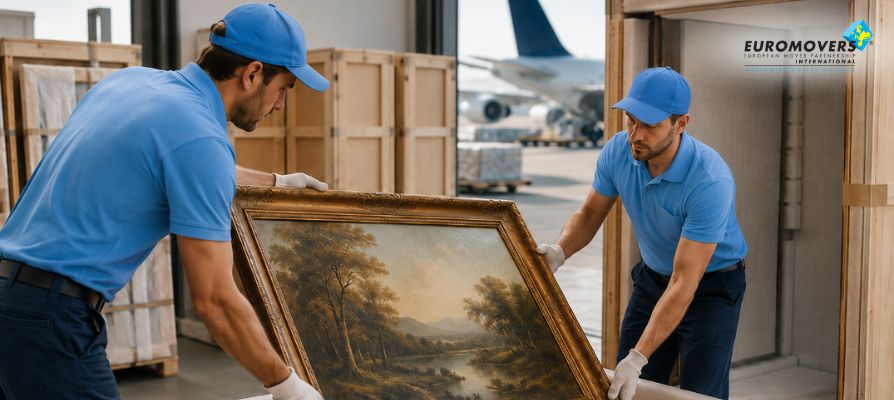
Fine art moving services are only truly effective when the shipment is planned around the artwork itself, not around a generic move schedule.
If you are transporting paintings, sculptures, framed works, antiques, installations, or mixed collections across borders, the real challenge is protecting value, condition, provenance, and timing at the same time.
This guide explains how to move fine art safely internationally, what professional art transport and handling services should include, and where risk usually appears before, during, and after transit.
You will also see how EUROMOVERS Worldwide Alliance supports international moves through approved member companies operating under shared standards, which is especially important when artwork must travel door to door with minimal handling. Fine art moving services begin with the condition, materials, dimensions, and handling needs of each piece.
International artwork transport is a specialist task because even small mistakes can create damage that is expensive, difficult, or impossible to reverse. A proper plan has to account for condition, packing method, route, climate exposure, customs timing, and handover control at both origin and destination.
Art is not just another fragile item. A canvas can react to pressure, vibration, humidity, and temperature changes in ways that standard household packing cannot manage.
Sculptures, ceramics, glass, mixed-media pieces, and framed works each need different protection, which is why experienced handlers separate them into different packing and transit decisions rather than applying one method to everything. Fine art moving services require a route plan built around the artwork rather than a generic shipment.
For international transport, the biggest risk is often not the truck journey itself but the number of times an item is touched, lifted, repacked, or transferred. The best fine art moving services reduce these handovers and keep responsibility clear from collection to delivery. When coordinated through professional international moving services, this approach helps protect valuable items while maintaining greater control and consistency throughout the entire international move.
A strong plan starts with a full inventory and condition review. That should identify dimensions, fragility, surface sensitivity, packing requirements, and any special handling notes. It should also confirm whether the piece can be shipped with others, needs dedicated space, or requires temperature and humidity control.
The plan should also include export and import timing, customs documents where applicable, destination access constraints, and an agreed delivery method. For collectors, galleries, designers, estates, museums, and private clients, this planning stage often makes the difference between a predictable move and one with avoidable surprises.
Safe fine art transport depends on a sequence of decisions made before the item is ever packed. Once the artwork is in motion, there is far less room for correction, so preparation matters more than last-minute intervention.
Fine art moving services should reduce unnecessary handling at every stage of the journey.
Before collection, every item should be inspected and recorded. That includes visible marks, frame condition, glazing, surface finish, mounting method, and any existing wear. For higher-value collections, clients often request photographic records so there is a clear baseline before transport.
This step is not just about claims protection. It also helps the packing team choose the right materials and avoid unnecessary contact with vulnerable surfaces. For example, a varnished painting and an unframed print may both seem delicate, but they need different barriers, supports, and spacing.
Artwork is safest when packing is built around the object rather than forcing the object into a standard carton. That usually means custom packing materials, edge protection, rigid backing, acid-free wrapping where appropriate, and secure immobilisation inside the outer crate or case.
Fine art moving services depend on accurate condition records before packing begins.
Oversized packaging can be just as risky as undersized packaging if the piece shifts during transit. Movement inside the pack can cause abrasion, corner damage, or frame distortion. Good packing limits motion while still allowing the artwork to breathe when needed.
The more times a piece is unloaded, inspected, reloaded, or re-sorted, the more the risk increases. For international shipments, it is usually better to plan a controlled door-to-door chain with as few transfers as possible.
That is where a governed network of approved partners becomes valuable, because the origin and destination handling teams can work to the same operational expectations. Fine art moving services need packaging selected for the object, surface, frame, and transit risk.
International artwork moves are often only as strong as the weakest handoff. If the origin pack-out is excellent but the destination partner is unfamiliar with the same standards, the shipment’s risk increases. International art moving requires customs and access planning to be completed before the collection date.
Custom crating is typically the right option when an item is irreplaceable, unusually shaped, framed in a vulnerable way, or sensitive to vibration and pressure. It is also useful when the artwork must travel long distance, pass through multiple stages, or remain stable during storage or customs delays.
Fine art moving services often justify custom crating for irreplaceable or unusually shaped works.
A well-built crate should support the object without squeezing it, and it should be designed for the specific dimensions, weight, and fragility of the piece. For mixed collections, different items may need different crate styles rather than a single shared solution.
Climate control helps reduce the impact of temperature swings and humidity changes that can affect canvases, paper, wood, adhesives, varnish, and some composite materials. It does not make a shipment invulnerable, but it can materially reduce the chance of warping, cracking, bloom, softening, or surface movement.
This matters most when artwork crosses seasons, moves through variable warehouse environments, or is likely to wait before final installation. Even a short exposure to poor conditions can be enough to cause visible change in sensitive pieces. Fine art moving services must consider vibration, pressure, humidity, and temperature together.
A climate-aware shipment still needs careful timing at pickup and delivery. If the artwork is left too long in a loading bay, exposed to rain during a transfer, or held in a vehicle with unstable conditions, the benefit of careful transit is reduced.
That is why experienced teams look at the entire route, not just the transport leg. Fine art moving services work best when packing, vehicle conditions, handover timing, and final placement are designed together rather than treated as separate tasks.
A professional moving company should do more than simply pick up and deliver boxes. It should coordinate the handling chain, protect the item from origin to destination, and keep the client informed at the points where risk is highest.
The most reliable providers usually combine assessment, packing, crating, transport planning, secure loading, and controlled delivery. Depending on the shipment, they may also coordinate storage, installation support, or destination unpacking. Fine art moving services work best when origin and destination handlers follow shared expectations.
In practice, the client should expect the provider to ask questions before quoting or scheduling. If no one asks about dimensions, materials, destination access, or value-sensitive handling, the service is probably too generic for fine art.
White glove art moving service standards usually mean the handling is discreet, careful, and coordinated around the item’s condition and presentation. That can include protective floor coverings, careful placement, controlled unpacking, and extra attention to how the artwork is transferred into the final room or display area.
Fine art moving services should include clear instructions for lifting, orientation, and placement.
For private homes, galleries, offices, hotels, and design projects, that level of finish matters because the move is not complete until the item is placed correctly. It also matters for installations where the final position affects lighting, wall support, or exhibition presentation.
International artwork moves are often only as strong as the weakest handoff. If the origin pack-out is excellent but the destination partner is unfamiliar with the same standards, the shipment’s risk increases. Fine art moving services need customs and access planning completed before the collection date.
EUROMOVERS Worldwide Alliance is relevant here because it connects approved member companies under shared governance and performance expectations. For customers, that means the artwork can move through one governed network with clearer accountability than a chain built on unknown or inconsistent agents.
Choosing the right partner is usually less about the slickness of the quote and more about whether the team understands the realities of handling valuable, fragile, or complex pieces across borders. A good partner should make risk visible before the shipment begins.
You should be comfortable asking how the company handles condition reporting, custom packing, climate-sensitive items, customs coordination, insurance documentation support, and destination delivery. The answers should be specific, not generic. Fine art moving services should separate climate-sensitive pieces from standard household cargo decisions.
A useful sign is whether the team explains trade-offs. For example, they should be able to tell you when a faster route may be less stable, when a crate is preferable to standard wrapping, or when a piece should travel separately from the rest of the shipment.
If a provider offers the same process for furniture, appliances, and artwork, the shipment may not receive the attention it needs. Other warning signs include vague packing descriptions, no mention of condition checks, limited discussion of climate exposure, or unclear responsibility for destination handling.
Artwork transport is not the place for assumptions. If the provider cannot clearly explain who handles the piece at origin, in transit, and at destination, the customer may be taking on more risk than expected. Fine art moving services require honest discussion of route stability, timing, and storage exposure.
A well-governed alliance model can help narrow the gap between different countries, languages, and operating practices. With EUROMOVERS Worldwide Alliance, the goal is to connect approved members who work to common standards so the customer has a more consistent door-to-door experience.
That structure is especially useful when the shipment crosses multiple jurisdictions or when the client needs one trusted origin partner and one trusted destination partner working in coordination rather than separately. Fine art moving services can protect provenance by keeping documentation organised throughout the move.
Even the best packing can be undermined by poor shipment planning. Fine art moves usually run more smoothly when logistics are treated as part of the protection plan, not as admin after the fact.
Depending on the origin, destination, and artwork type, the shipment may need inventory details, value information, ownership notes, customs paperwork, and supporting records for import or export checks. Requirements vary by country and shipment context, so they should always be verified in advance.
Fine art moving services should use inventory controls that remain consistent at every handover.
It is also wise to keep a separate file with photographs, dimensions, and any installation notes. That makes destination placement easier and supports faster problem-solving if anything needs to be checked on arrival.
Fine art deliveries can be complicated by stair access, narrow lifts, limited parking, building time windows, or security restrictions. These details affect not only delivery speed but also how the artwork is carried, lifted, and positioned.
If the final destination is a private residence, showroom, office, or gallery, the delivery team should know exactly what they are walking into before the vehicle arrives. This avoids rushed handling, additional lifting, and avoidable exposure outside the building.
Fine art moving services need destination access checked before crates reach the delivery address.
The most helpful client input is accurate information. Dimensions, installation location, access constraints, and a clear contact at both origin and destination help the team plan well. Clients do not need to manage the packing themselves, but they should make the artwork, the environment, and the timeline easy to understand.
When that information is shared early, the shipment is easier to sequence, and the final placement is more likely to happen without unnecessary handling or delays.
According to Deep Market Insights, the Germany Moving Services Market was valued at USD 7,703.68 billion in 2025 and is projected to reach USD 11,892.71 billion by 2034, reflecting steady growth throughout the forecast period.
Fine art moving services work best when the shipment is built around protection, not convenience. The safest international moves are usually the ones that combine careful condition checks, artwork-specific packing, custom crating where needed, climate-aware transport, and tightly controlled handovers from origin to destination.
If you are moving valuable artwork internationally, the key decision is not simply who can collect the piece. It is who can manage the full handling chain with the discipline the artwork deserves.
EUROMOVERS Worldwide Alliance supports that goal through approved member companies operating under shared standards, giving you a more consistent and accountable door-to-door experience when artwork must travel across borders. Fine art moving services may include controlled storage when installation or occupancy is delayed.
This guide is produced and reviewed by the EUROMOVERS editorial team in coordination with accredited member companies across our global network. Rather than reflecting one mover’s view, it draws on shared standards and field experience from a European-founded alliance operating in 40+ countries under one governance model.
Stay updated with the latest news, tips, and insights from the world of relocation. Our blog shares expert advice, helpful guides, and stories to make your moving experience easier and more informed.

Moving to China from USA can feel overwhelming when immigration decisions, family logistics, shipping arrangements, and unfamiliar customs procedures must...

Best international moving networks are not simply lists of companies in different countries; they are operating relationships that help professional...

Global employee mobility becomes difficult when an employee’s move depends on disconnected suppliers, unclear responsibilities, or an unknown partner at...