
New road tunnel to open in London
Transport for London (TfL) has confirmed that the new Silvertown Tunnel will open on 7 April, 2025. The new tunnel,...
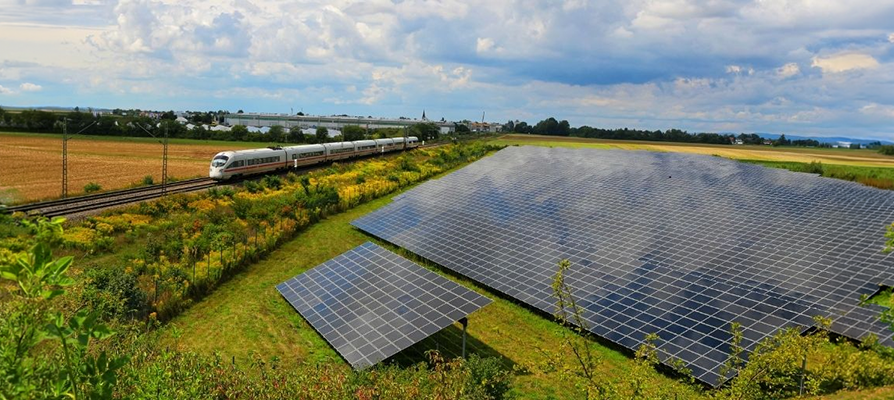
ATÜV Rheinland study for the German Center for Rail Transport Research (DZSF) at the German Federal Railway Authority has shown the potential of photovoltaic (PV) applications on and in the rail infrastructure.
The final report, just published by the DZSF, says that PV systems can not only be integrated into the rail infrastructure under the given boundary conditions, but that it is also technically possible to feed the solar power generated directly into the overhead line network. TÜV Rheinland said the potential of PV applications on the German rail infrastructure was for up to 2,940 gigawatt hours of solar power per year.
Photovoltaic potential
The report said that more than a quarter of the railway’s total annual electricity requirements can be generated sustainably by PV modules in the track bed, on and in noise barriers, on noise protection walls and open areas close to the tracks, as well as on the roofs of buildings and trains.
“Most of the solar power is fed directly into the overhead line network, with only a small proportion going to the railroad’s own buildings on the infrastructure,” said Jürgen van der Weem, railway technology expert and project manager at TÜV Rheinland. “Direct feed-in is a feature of decentralised power generation. The electricity is generated where it is needed. The energy losses caused by repeated conversion and transportation are significantly lower.”
Two years of research
The 260-page study, which three rail experts and three photovoltaic experts from the testing service provider produced over two years of research on behalf of the DZSF, is both an inventory of the rail infrastructure and a source of inspiration for greater sustainability. All relevant PV systems and components available on the market were intensively examined regarding their suitability for railroad technology. Compared to conventional PV systems, a particular technical requirement was to investigate the specific influences, such as how vibrations and soiling affect PV components in the track bed.
The annual potential of 2,940 gigawatt hours of solar power would cover almost 27 per cent of the total electricity demand with an average annual electricity demand of around 11,000 gigawatt hours.
TÜV Rheinland has recommended, however, that the project proceeds cautiously by introducing PV components to ground-mounted systems, railroad stations, canopies, noise barriers and noise protection walls. This will provide an initial PV potential of 380 gigawatt hours and could be implemented in the short term with the minimum of risk.
Rail is not currently used extensively in the international moving industry. However, as corporate customers increase their demands on suppliers to reduce Scope 3 emissions on their behalf, it could become a more practical option in the future.
Read Also: Change of name and change of address at Frachtmeister International
Stay updated with the latest news, tips, and insights from the world of relocation. Our blog shares expert advice, helpful guides, and stories to make your moving experience easier and more informed.

Transport for London (TfL) has confirmed that the new Silvertown Tunnel will open on 7 April, 2025. The new tunnel,...
According to a new paper by DNV issued on 21 October 2025, shifting environmental requirements are reigniting interest in nuclear...

Nord-Transport AG (“NT”) in Basel has become part of the Schneider Group. NT has strong local roots, acts globally and...