
When and How to Plan an Office Move for a Growing Business
An office move for a growing business becomes much easier to control when you recognise the right signals early, rather...
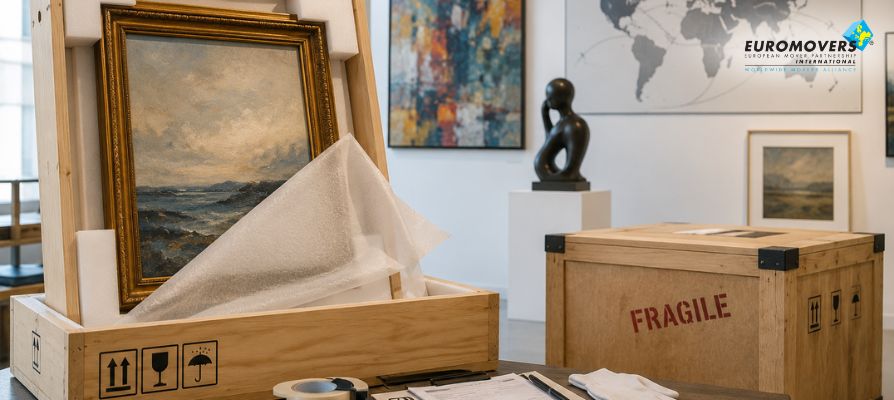
International art shipping becomes difficult when a valuable work is treated like an ordinary parcel, leaving condition, customs, access, and delivery decisions until the last minute.
For international art shipping, for collectors, galleries, estates, and businesses moving artwork internationally, the right plan connects specialist handling with accurate documentation and dependable origin-to-destination coordination.
This guide explains what to prepare, when custom crating or climate-controlled options may matter, how to assess providers, and how approved EUROMOVERS members can support the process through one governed global network.
For international art shipping services, the first decision is not which transport mode looks cheapest. It is what the artwork requires at every stage of its journey.
A framed oil painting, a rolled work on paper, a bronze sculpture, and a mixed-media installation may all travel internationally, but they do not share the same packing, access, handling, or documentation needs.
A professional assessment should therefore begin with the objects, the route, the buildings, and the purpose of the move. A household collection moving to a new residence may need careful scheduling around a wider relocation.
A gallery sending work to an exhibition may have a fixed opening date, temporary import arrangements, and return transport to consider.
For international art shipping, create an inventory before packing begins. Record the artist, title, medium, dimensions, frame or plinth details, approximate weight where known, value information, photographs, and any existing damage or conservation notes. The inventory should distinguish the artwork from its packing materials and accessories.
Condition photographs are particularly useful when a work has a delicate surface, an ornate frame, loose elements, or a history of restoration.
Photograph the front, reverse, corners, frame, fixings, and any existing marks. These records do not replace a conservator’s report, but they create a practical reference for collection and delivery handovers.
For international art shipping, tell the shipping specialist about unusual characteristics. Examples include fragile glazing, impasto paint, unfixed media, moving parts, protruding elements, wax, resin, natural materials, or works that must remain upright. Omitting such details can result in an unsuitable packing method or an inaccurate estimate.
Packing is a form of risk management, not a cosmetic extra. Some works may need protective wrapping and a purpose-built inner support. Others may require a custom crate with controlled movement inside, shock protection, or a design that allows safe inspection and unpacking.
Custom crating for artwork should account for the object’s geometry, centre of gravity, vulnerable surfaces, lifting points, and the likely handling environment.
A crate that is safe for a robust sculpture may be unsuitable for a glazed painting. Likewise, a frame can require more protection than the artwork itself if it has delicate carving or gilded surfaces.
For international art shipping, avoid packing artwork yourself immediately before collection unless the appointed specialist has agreed the method. Well-intentioned household materials can trap moisture, abrade surfaces, transfer residue, or prevent the handler from checking the condition properly.
A shipment plan should consider staircases, lifts, loading bays, narrow corridors, restricted roads, security procedures, and destination access. Large works may require a pre-move survey at one or both addresses. Galleries should also consider whether the receiving venue has delivery windows, freight lift bookings, security rules, or installation requirements.
Transit time is only one part of the schedule. Packing, documentation, collection, border processing, delivery appointments, unpacking, and inspection all need space in the plan. A collection intended for an exhibition should not be scheduled on the assumption that the transport leg alone determines the arrival date.
For fine art shipping, collectors arranging an international household move should separate essential household delivery from artwork delivery where practical. This can make it easier to use temporary storage if the new property is not ready, while protecting valuable pieces from being left in an unsuitable environment.
Prepare a complete inventory and photographs before requesting a quotation. The more accurately the provider understands the collection, route, access, and timing, the more meaningful the proposed service and cost assessment will be.
For international art shipping, the most visible part of a shipment is the vehicle, but many risks arise before and after transport.
Artwork may be lifted through a building, transferred between teams, stored temporarily, presented for inspection, or unpacked in a room that was not ready for it. Art transport and handling services should address this entire chain rather than focusing only on the journey between two addresses.
A useful way to assess the plan is to ask who is responsible at each handover. The collection team, packing team, transport coordinator, customs contact, destination team, secure storage solutions, and installation crew may all have different roles. Those roles should be clear before the shipment starts.
For international art shipping, paintings can be vulnerable to vibration, impact, pressure on the surface, unsuitable wrapping, and changes in environmental conditions.
Works on paper may require especially careful protection from light, moisture, abrasion, and bending. Sculptures can present different challenges because of weight distribution, fragile projections, unstable bases, or concealed fixing points.
Mixed-media works deserve a detailed discussion with the specialist. Components made from different materials may respond differently to temperature or humidity changes. An installation may also need to be dismantled, labelled, photographed, and reassembled in a defined order.
Handling instructions should be specific. “Fragile” is not enough. Note whether the work must remain upright, which side is the top, where it can be lifted, whether gloves or special supports are needed, and whether the crate may be tilted.
Clear instructions reduce the chance of assumptions during a busy handover.
For international art shipping, climate controlled art shipping may be considered when the artwork, route, season, duration, or value makes environmental stability an important part of the risk assessment.
It is not automatically required for every shipment, and “climate controlled” should be discussed precisely: the relevant conditions, monitoring approach, transit stages, and storage arrangements should be understood.
Environmental needs can vary by medium and by the work’s existing conservation history. A conservator, gallery registrar, insurer, or art logistics specialist may provide useful guidance for particularly sensitive pieces.
The shipping plan should also consider periods outside the vehicle, such as loading, customs examination, temporary storage, and delivery waiting time.
For international art shipping, a custom crate may protect against impact, handling pressure, and movement when designed around the individual work. It can also make lifting and orientation clearer.
However, crating takes time, may require measurements or a site visit, and can affect collection and delivery access because of the finished dimensions.
Ask whether the crate is intended for one journey, repeated exhibition use, or storage. A reusable exhibition crate may need different construction and labelling from a one-way household relocation crate. Discuss opening instructions, fasteners, internal supports, and where the crate will be kept after delivery.
For a gallery, the packing record should link each work to its crate and destination. For a collector, the same discipline helps ensure that a multi-room collection is returned to the correct location without unnecessary handling.
For international art shipping, shipping fine art overseas involves more than arranging collection and transport. Customs, tax, export controls, import conditions, temporary admission arrangements, cultural-property rules, and insurance requirements can vary according to the countries involved, the artwork, its value, ownership, and the reason for shipment.
There is no universal document pack that guarantees a smooth crossing. The correct requirements must be verified for the specific origin, destination, route, and transaction.
A professional moving or art logistics provider can help organise information and coordinate with relevant specialists, but customers should not assume that transport coordination replaces official customs or legal advice.
For international art shipping, a quotation may refer to customs support, but clarify what that means. It might include preparing shipment information, coordinating with a customs broker, or arranging documents through an appointed party.
It may not include taxes, duties, permits, legal opinions, conservation assessments, or decisions made by government authorities.
Common information requested for an artwork shipment can include an itemised description, dimensions, weight, value, country of origin, ownership details, sale or loan information, and photographs. The exact format and supporting evidence vary. Descriptions should be consistent across the inventory, commercial paperwork, insurance information, and transport instructions.
Do not understate value to reduce apparent cost or simplify paperwork. An inaccurate value can create problems for insurance, claims, customs review, and the recipient’s records. If the work is being loaned or temporarily exhibited, state that clearly rather than describing it as a sale or permanent import.
For international art shipping, a gallery sending works to an overseas exhibition may have different requirements from a collector permanently relocating a private collection.
A sale can involve commercial documentation and tax considerations. A temporary movement may require evidence that the work is returning or that the arrangement meets the relevant temporary admission process.
The route may also pass through more than one country, creating additional transit considerations. The shipment should be planned with the full itinerary in mind, not only the first border. For culturally significant or restricted objects, specialist advice may be needed before the collection date.
A practical example is a gallery dispatching ten works to a fair. The transport itself may be straightforward, but the shipment can still be delayed if the crate list, invoice descriptions, temporary import information, and receiving venue details do not match.
Early document review can expose these inconsistencies while there is still time to correct them.
For international art shipping, create one controlled information set for the collection. Keep the latest inventory, photographs, values, condition notes, packing references, and contact details together. Record which documents have been supplied, who is responsible for each action, and which items remain subject to confirmation.
Check requirements with the relevant customs authorities, tax advisers, cultural-property specialists, insurers, and receiving institutions where appropriate. Rules can change and may differ even between apparently similar routes. Avoid relying on an old shipment file simply because the destination is the same.
For international art shipping, approved EUROMOVERS members can help coordinate moving and delivery activities at origin and destination, while route-specific official requirements remain subject to the relevant authorities and advisers.
The provider with the lowest initial price is not necessarily the least expensive option once repacking, storage, missed delivery windows, damage risk, or unclear responsibility is considered. When comparing international art shipping services, assess the complete operating plan and the people accountable for it.
You should be able to understand what happens at collection, how the work is packed, how it is transported, where it may be stored, who manages border coordination, how the destination team receives it, and what is included in unpacking or installation.
If the proposal is vague at any of these points, ask for clarification before appointing anyone.
For international art shipping, ask how the provider will assess the artwork and whether a physical survey is needed. Confirm how condition is recorded, whether packing is performed by trained personnel, how crates are labelled, and how exceptional handling instructions are communicated.
Also ask about access. Will the team check the collection address, destination entrance, lift dimensions, loading restrictions, parking, security, and delivery windows? For a gallery, ask whether the service can align with registrar instructions, venue requirements, and an exhibition schedule.
Clarify storage separately from transport. If storage may be needed, ask where it occurs, how access is controlled, what environmental information is available, and how the work will be released for onward delivery. Do not assume that a transport provider’s standard storage arrangement is suitable for every artwork.
For international art shipping, finally, discuss insurance and claims before the move. Understand whether cover is arranged by you, the provider, or another party; what information is needed; and whether exclusions or valuation conditions apply.
Insurance cannot repair a work or recover a missed exhibition opening, so prevention and clear planning remain important.
International shipments commonly involve more than one operating team. The origin team may know the collection address and packing requirements, while the destination team understands local access, delivery customs, and receiving procedures. The handover between them must be managed rather than assumed.
For international art shipping, this is where an alliance model can provide useful structure. EUROMOVERS Worldwide Alliance is a European-founded global mobility alliance of approved professional moving companies.
It does not perform the move itself. Services are delivered by approved members, with origin and destination companies working within a governed network that includes shared operational standards, common quality requirements, and structured performance monitoring.
For a collector or gallery, the practical benefit is a clearer route to accountability than appointing unrelated companies independently. One approved member can coordinate at origin and another at destination, reducing reliance on unknown agents while preserving the local expertise needed at each end.
The model does not remove the need to check the specific proposal. Confirm the named member companies, scope, contacts, responsibilities, documentation support, storage arrangements, and delivery conditions. Governance supports consistency, but the shipment still needs to be designed around the artwork and route.
For international art shipping, ask providers to separate major cost drivers: survey and packing, custom crating, transport, border-related coordination, storage, delivery access, unpacking, installation, and insurance-related charges. A lower quote may exclude work that another provider has included.
For a small collection, a carefully planned consolidated service may be considered where timing and compatibility allow.
For highly valuable, urgent, unusually fragile, or exhibition-critical work, a dedicated arrangement may offer more control but can cost more. The right choice depends on the collection, route, deadline, and acceptable risk—not on a general rule.
Speak With An Art Shipping Professional Before Collection [Talk To A Moving Professional].
Delivery is the final operational stage, not an administrative afterthought. A work can arrive safely but still face risk if the destination room is inaccessible, the installation surface is unprepared, or the recipient signs without checking the package and condition.
For international art shipping, prepare the destination before dispatch where possible. Confirm the delivery address, access route, contact person, opening hours, security arrangements, lift or loading requirements, and the room where each work will be placed.
For large or heavy pieces, confirm that the floor, wall, fixing system, and installation method are appropriate.
Galleries should align delivery with registrar, curator, security, and installation responsibilities. Decide who will authorise unpacking, who will inspect the work, and who will record any condition changes.
If the exhibition venue cannot receive the work immediately, arrange an appropriate holding solution rather than leaving the crate or artwork in an uncontrolled area.
For international art shipping, collectors should avoid treating a newly delivered work as ordinary household furniture. Keep the receiving area clear, protect floors and doorways, and allow the handling team enough space to open crates safely.
If a move is part of a wider relocation, agree whether artwork is delivered to the residence, a specialist storage location, or another approved destination.
Check the external packaging first. Look for impact marks, punctures, water exposure, broken fasteners, crushed corners, or signs that the crate has been opened. Photograph anything unusual before unpacking, then compare the work with the original condition record.
If damage or a discrepancy is found, notify the relevant contact promptly and follow the agreed claims or incident process.
Record facts rather than assumptions: note the crate number, location of damage, photographs, condition details, date, and people present. Do not discard packing materials until the responsible party confirms that they are no longer needed.
For international art shipping, a clean handover should also confirm that every item has arrived, accessories and fixings are accounted for, and any agreed unpacking or placement work is complete. For a multi-piece installation, verify the component list before the team leaves.
Buildings are sometimes delayed, exhibition schedules change, and customs processing may take longer than expected. A realistic plan includes what happens if the destination cannot receive the work on the original date.
Temporary storage, revised delivery slots, and additional handling may affect the final cost and should be discussed before they become urgent.
The same applies to a collector’s relocation. If the new home is not ready, specialist storage may be safer than repeated household handling. Ask how the work will be released, inspected, and delivered when the property becomes available.
For international art shipping, planning these contingencies does not mean expecting failure. It means protecting the artwork and the wider schedule when circumstances change.
According to Deep Market Insights, the Germany Moving Services Market was valued at USD 7,703.68 billion in 2025 and is projected to reach USD 11,892.71 billion by 2034, reflecting steady growth throughout the forecast period.
International art shipping is best approached as a connected chain of decisions: identify the artwork, record its condition, design suitable packing, verify the route and documents, plan access, assign responsibility at every handover, and prepare the destination before delivery.
Collectors and galleries should compare complete service scopes rather than headline transport prices. Ask who is responsible, which activities are included, how unknown-agent risk is reduced, and what happens if access, customs, storage, or timing changes.
For international art shipping, EUROMOVERS Worldwide Alliance can provide a structured network context for this planning. As a European-founded global mobility alliance of approved professional moving companies, it connects approved members operating under shared standards, common quality requirements, governance, and performance monitoring.
The alliance does not perform the shipment; services are delivered by approved members coordinating support at origin and destination.
When your collection, exhibition, or art collector relocation requires international art shipping, request a route-specific assessment from the relevant approved member and provide complete artwork, access, timing, and documentation information from the beginning.

This guide is produced and reviewed by the EUROMOVERS editorial team in coordination with accredited member companies across our global network. Rather than reflecting one mover’s view, it draws on shared standards and field experience from a European-founded alliance operating in 40+ countries under one governance model.
Stay updated with the latest news, tips, and insights from the world of relocation. Our blog shares expert advice, helpful guides, and stories to make your moving experience easier and more informed.

An office move for a growing business becomes much easier to control when you recognise the right signals early, rather...
Pet relocation becomes much easier to manage when you treat your pet’s journey as a separate project within the wider...

Commercial moving company selection becomes difficult when an office move affects employees, customers, equipment, records, and daily revenue at the...